
Going Furthur: On Tom Wolfe, The Grateful Dead, and Mourning Routine
What Tom Wolfe, The Grateful Dead, and a School Bus Taught Me About Making Music
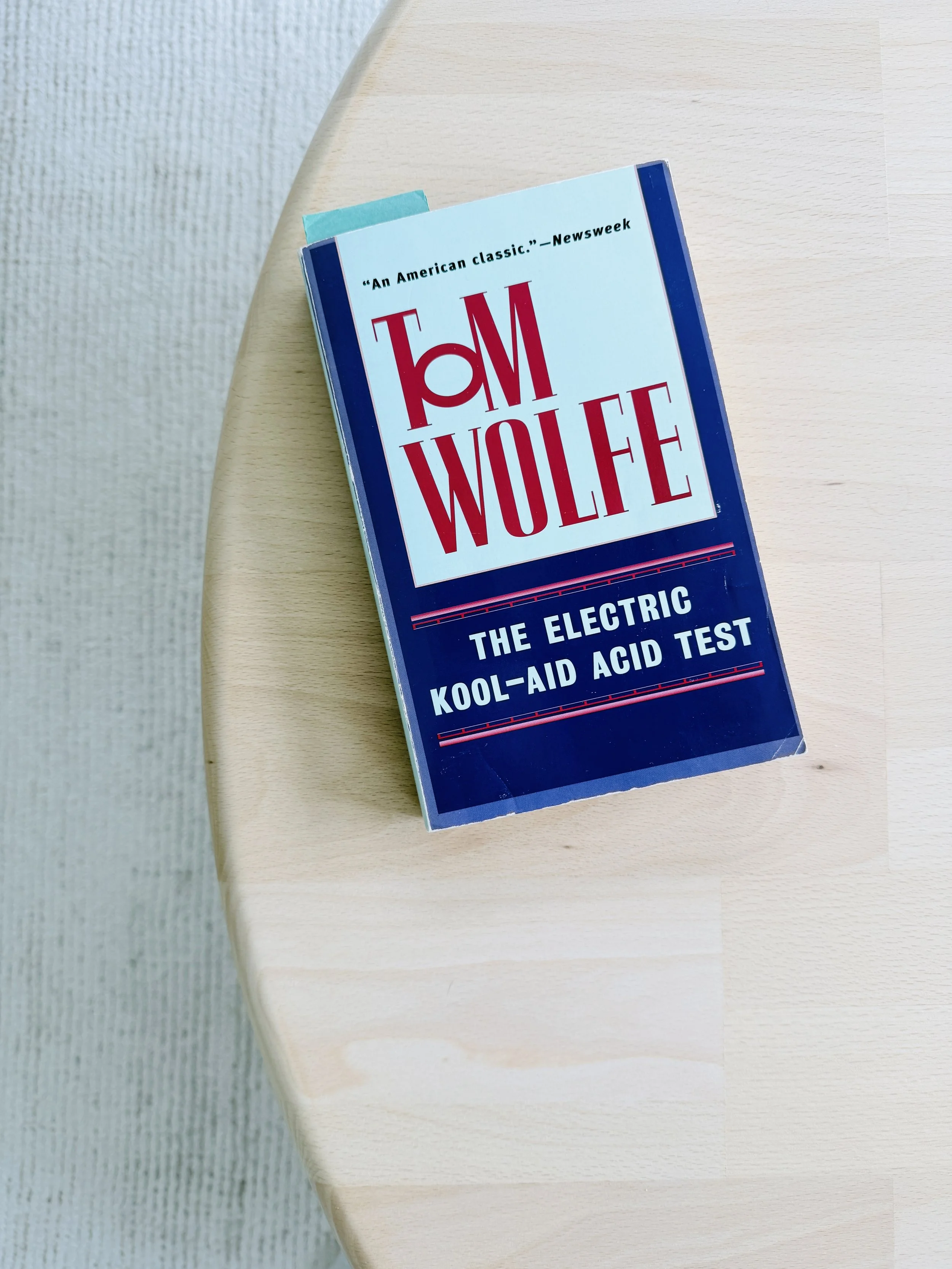
I just finished reading The Electric Kool-Aid Acid Test by Tom Wolfe, and I can't stop thinking about it. The book chronicles Ken Kesey and the Merry Pranksters — a group of writers, artists, and seekers who, in the mid-1960s, painted a school bus in psychedelic colors, named it Furthur, and set out across America with the goal of, well, going further. Further into experience. Further into art. Further into whatever was on the other side of the next bend in the road.
I bought this book back in high school. I made it about a hundred pages in before bailing. The themes, the writing style, the life experiences Wolfe was describing — none of it connected. I shelved it and forgot about it.
Years later, with more life in the experience bank, a brief encounter with psychedelics in my past, and a more open mind, I picked it up again. And this time it absolutely floored me.
A Different Kind of Writing
Wolfe's prose is its own kind of trip. What's come to be known as "gonzo" journalism — that immersive, first-person, breathless style — really does feel like being pulled along by someone running ahead of you, looking back over their shoulder and shouting "come on, come on, keep up!" The pacing mirrors the psychedelic experience itself: fragmented, kaleidoscopic, somehow holding together even when it shouldn't.
What struck me most was how elegantly Wolfe wove together so many tales and perspectives into one cohesive journey. Dozens of characters, dozens of scenes, all moving at the speed of a bus barreling down a desert highway with Cassady at the wheel — and yet by the end, I really did feel like I'd been on that bus with Kesey and the Pranksters. That kind of writing isn't just descriptive. It's transportive. It puts you inside something.
The Grateful Dead Connection
Part of what brought me back to Electric Kool-Aid was a recent deep dive into The Grateful Dead and their history (more on that in a future blog — there's a lot to say). What I hadn't fully appreciated until reading Wolfe's book is how foundational the Pranksters were to The Dead's early evolution. The Dead played most of the Acid Test parties Kesey and the Pranksters hosted in the mid-60s. Some music historians argue that those gatherings are how The Dead actually became The Dead — long-form, improvisational, willing to follow a song wherever it wanted to go, comfortable with not knowing what was coming next.
That's a powerful idea for any artist. The Dead didn't become The Dead by deciding what they were going to be and executing on it. They became The Dead by showing up to the Acid Tests, plugging in, and seeing what happened. The form found them through the practice.
Going Furthur
The Pranksters had a phrase painted across the front of their bus: "Furthur." Misspelled on purpose. A direction more than a destination.
That word has stuck with me since I finished the book, because it describes something I recognize in my own creative life. With Six Missing, I try to continually push into new sounds, new methods, new approaches to crafting work. It's very unusual for me to do anything the same way twice. Each release is a chance to explore a different corner of what's possible — different textures, different emotional registers, different production philosophies. Sometimes I don't know where a song is going until I'm already in the middle of it. Sometimes the best material comes from following an idea past the point where I would've normally stopped and turned back.
Reading about the Pranksters made me realize that sense of restlessness isn't a bug. It's the whole point. You go furthur because the interesting stuff is past the edge of what you already know how to do.
In that way, I feel like I would've been welcomed on the bus. (I sometimes wonder what my nickname would've been — Echo Echo, maybe?)
A New Exploration: Mourning Routine
That sense of going furthur is exactly the spirit behind my latest single, Mourning Routine. It's a song I wrote in a headspace not entirely unlike the one Wolfe captures in Electric Kool-Aid — interested in what happens when you sit with discomfort instead of running from it, when you let an idea unspool rather than forcing it into a shape you already recognize. Sonically, it's a step into territory I haven't worked in before, which is becoming a pattern I'm proud of.
Mourning Routine is the leading track off my new EP, Passed Self, out June 5th. The EP as a whole is about the versions of yourself you've outgrown — the routines, the patterns, the people you used to be that you've quietly left behind. It's a record about transition, and about the strange grace of recognizing where you've been from the vantage point of where you are now.
I think there's a thread that connects all of this — Kesey and the Pranksters, The Dead at the Acid Tests, the act of going furthur, and the small, private process of writing songs that move you somewhere new. It's all about being willing to leave the version of yourself you know behind. To get on the bus, even when you don't know where it's going.
Read Anything Good Lately?
If you're a reader, I'd love to hear what's been on your nightstand. I just started Dungeon Crawler Carl and I'm excited to spend more time with it. And if you've read Electric Kool-Aid — or you've been meaning to — I'd love to hear what you made of it.
You can listen to Mourning Routine now. Passed Self arrives June 5th.
Thanks, as always, for being here.